Beekeeping Hive and the Right Home for Your Bees
A beekeeping hive is one of the absolute essentials you will need with beekeeping. Unlike the past, beekeepers today have a wide range of beekeeping hives to choose from.
Bees are particular about the home they are willing to live in, so providing the right haven for your bees is essential if you want happy, productive bees willing to stay put. Fortunately, for them and for you, today's hive is a bit different from the ancient beekeeping one.
Here's what you need to know.
The Method From Ancient Times
If you watched Russell Crowe's version of Robin Hood a few years ago, you might have noticed that Friar Tuck kept bees in baskets shaped like large bells. These ancient beekeeping hives were called skeps and were the most popular housing for bees for centuries.
Visually, the skep looks appealing, but this form of ancient beekeeping is rarely used today because it is so impractical. With a skep, there is no way to visually inspect your bees regularly to make certain they are healthy, a must for today's professional beekeeper.
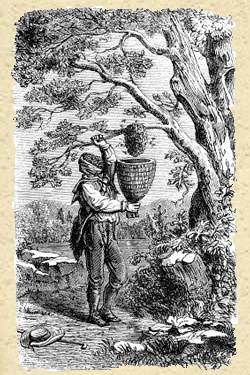
Ancient beekeeping methods included keeping your bees in a skep and collecting new swarms each spring.
Also, with the skep, beekeepers were unable to harvest honey without destroying both the bees and their comb. That meant they would have to collect new swarms each spring, as well as build a new skep. These days, with colony collapse disorder, environmental toxins, and other dangers to bees. These valuable insects are simply too valuable to be housed that way.
The Langstroth Beekeeping Hive
All of that changed, thanks to the Rev. Lorenzo L. Langstroth of Pennsylvania, who in 1851 invented a new hive that is far simpler and more practical, and which is still a popular beekeeping hive today.
The basic parts of this hive include a hive stand, a bottom board, a lower deep, an upper deep, the honey super, the inner cover and outer cover.
The Hive Stand
The hive stand is a supportive structure that keeps the hive off the ground. It's crucial because it keeps the hive off the ground, keeping things from getting damp and allowing the circulation of air into the hive. Also, since the hive stand lifts the hive off the ground by a few inches, it makes it easier for your bees to get around any grass growing nearby and into the hive.
The Bottom Board
As its name suggests, the bottom board is the floor of your beehive. You have the option of either a solid bottom board or a screened one. A solid bottom board will help your bees stay warmer during the cold winter nights. A screened bottom, on the other hand, allows the free movement of air into the hive.
If you live in a humid climate, your hive will be better off with a solid bottom because it keeps the humidity out of the hive, meaning less chance for mold to grow.
Mites are a problematic parasite that attacks your bees and impairs their health. A screened bottom board will help keep the mites out and make for happier bees. The bottom board also has what is known as an entrance reducer, limiting the number of bees that can get into the hive. This makes it easier for your bees to defend the hive. Also, it keeps the hive warmer in the winter months.
Deep-Hive Bodies
Known as the upper deep and lower deep, these bodies are a crucial part of your beekeeping hive. The lower deep is where your queen will lay brood - the next generation of bees. The upper deep is where bees will store honey and pollen for their food.
The upper deep will hold frames. It's on these frames that bees will build their hives and fill them with honey. Most beekeepers put foundation, which is a thin sheet of plastic covered with beeswax inside the frames. That encourages the bees to build their honeycombs in a straight line on the foundation. Here they will make honey that they will feed on through the winter months.
Honey Super
This is where your honey is stored - the surplus honey bees make that you can collect and enjoy.
They are identical to the upper and lower deeps, but shallower in depth.
About the Author
My name is Sue Merriam, and I began the journey of self-reliant living more than three decades ago, which enabled me to stay home with my children. Fifteen years ago, I founded Joyful Homesteading to help others save money and face the future without fear. My goal is to give you practical, honest advice so you can save money and experience the joy of simple living. I hope you join me.
Recent Articles


-
Homesteading Legal Restrictions in HOA Communities
Aug 31, 26 05:48 PM
 Homesteading legal restrictions in HOA communities is possible, but check with your HOA and local laws.
 -
Solar Batteries for Emergency Backup During Outages at Home
Aug 19, 26 12:23 PM
 Learn what solar batteries can realistically power in an outage, how long they last, and what works best for you.
 -
Facts About Solar Panels
Aug 15, 26 10:30 PM
 Facts about solar panels are good to know when considering solar power for your off the grid homestead.