Sea Salt vs Table Salt
Sea salt vs table salt: so what's the difference? The answer is that lower blood pressure and better health can be yours by adding sea salt to your diet on a regular basis and eliminating the other kind.
Salt is crucial to our survival and helps with a number of functions in the human body, including nerve impulses, muscle contraction, and the movement of nutrients into our cells.
You can get salt in a number of ways, but not all salts are alike, and some salts are better for you than others.
The four main types of salt are table salt, kosher salt, sea salt and iodized salt (table salt with iodine added in).
Table Salt
Table salt is made up of 99.9% sodium chloride and is salt that has been mined, heat-blasted, and chemically treated.
All other minerals have been stripped from it, and usually anti-caking agents are also added to make the salt free-flowing.
Later on, iodine was added to table salt to help prevent such diseases
as hypothyroidism, pregnancy-related problems, and an enlarged thyroid.
In addition to adding iodine to table salt, anti-caking ingredients are added to keep the salt from clumping. This is typically sodium aluminosilicate, which is used to absorb moisture. Because it has aluminum in it, it could pose a potential health risk, ncluding Alzheimers disease. Other potential health risks include neurotoxicity.
Sea Salt
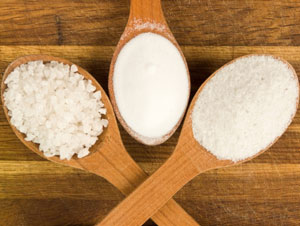
Sea salt is simple, unrefined salt created by evaporating sea water. Typically, seawater is channeled into protected, man-made pools and allowed to dry under the sun.
Because sea salt is made from seawater, this adds color and flavor to the salt, and you can purchase the salt in either crystals or fine grains. You can also purchase sea salt that contains iodine. Because sea salt has been processed minimally, it may contain trace minerals, depending on where the seawater came from.
Sea salt is about 98 percent sodium chloride and may have other valuable minerals such as sulfur, iron, magnesium, and other trace elements, providing important nutrients.
Sea Salt vs Table Salt - What's the Difference?
One of the benefits of sea salt vs table salt is that your body will process sea salt more naturally, and it won't raise your blood pressure the way table salt would. There are also many health benefits associated with sea salt, including helping your kidneys, adrenal glands, and liver work more efficiently and strengthening your immune system.
Get Your Iodine
If you choose to use sea salt, you will need to either purchase an iodized sea salt or use a kelp supplement (find it online here). Add kelp powder to your next soup recipe if you want to get a more natural form of iodine (find kelp powder online here).
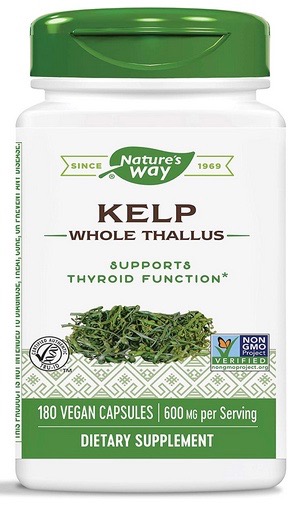
A great way to support your thyroid is to use a kelp supplement like this one.
How Does it Taste?
Taste is, of course, an important factor when considering sea salt vs table salt, and because sea salt has other minerals in it besides sodium chloride, you may find the taste less salty than with regular table salt.
Also while table salt will be pure white, sea salt may be gray, white, red, or even black in color. You can even use Himalayan pink salt, although that is a mineral salt harvested from the Himalayan Mountains rather than the sea.
What About Himalayan Salt?
Himalayan salt comes from the Himalayan foothills located in the Punjab region of Pakistan. The trace minerals in Himalayan salt give it a unique taste and color. In addition, Himalayan salt could contain trace minerals, including iron, calcium, magnesium, potassium, and zinc. Himalayan salt also contains iron oxide, which gives the salt its pink color.
Himalayan salt contains a bit less sodium than table salt. And sodium is important, because, let’s face it: your body needs salt. Without it, your body can’t retain water, meaning you become dehydrated much quicker. Without salt, your blood pressure will drop, and you could die. But you only need a small amount of sodium. Eat too much of it, and your kidneys will suffer potential strain trying to rid it from your body.
Still, although Himalayan salt has a bit less sodium, the difference isn’t that great. It won’t hurt you to eat Himalayan salt, and it’s certainly pretty. Just keep in mind that it’s more a culinary choice than a health one.
Learn More About Self Reliant Healing
Return from Sea Salt vs Table Salt to Home
About the Author
My name is Sue Merriam, and I began the journey of self-reliant living more than three decades ago, which enabled me to stay home with my children. Fifteen years ago, I founded Joyful Homesteading to help others save money and face the future without fear. My goal is to give you practical, honest advice so you can save money and experience the joy of simple living. I hope you join me.
Recent Articles


-
Benefits to Organic Gardening
Sep 21, 26 03:37 PM
 Benefits to organic gardening include the best, fresh delicious harvests.
 -
Homesteading Legal Restrictions in HOA Communities
Aug 31, 26 05:48 PM
 Homesteading legal restrictions in HOA communities is possible, but check with your HOA and local laws.
 -
Solar Batteries for Emergency Backup During Outages at Home
Aug 19, 26 12:23 PM
 Learn what solar batteries can realistically power in an outage, how long they last, and what works best for you.