The Herb Chickweed
Herb Chickweed is, well, a weed. After all, with the word "weed" in the name, you know it's got to be one of those plants that grows so easily and so fast that it will take over your garden, your lawn, and any other space that has soil. So why grow it, you may ask? Because, like dandelions, chickweed has gotten a bad rap over the years.
Chickweed was loved and prized by our ancestors for centuries. The Ancient Greeks, Romans, and Egyptians used this herb to treat many ailments, and early Europeans relied on it to treat eye infections. Our ancestors also used this handy little herb to treat digestive problems, skin conditions, and respiratory ailments.
A member of the carnation family, Chickweed’s botanical name is Stellaria Media. It earned its name because chickens and other poultry love it, so if you have a backyard flock, think about growing it for your laying hens. They not only like the tops, but they also love the seeds, and with all those healthy vitamins and minerals, your flock will produce even more nutritious eggs.
According to A Modern Herbal (Volume 1, A-H): The Medicinal, Culinary, Cosmetic and Economic Properties, Cultivation and Folk-Lore of Herbs, Grasses, Fungi, Shrubs & Trees with Their Modern Scientific Uses, "Pigs like Chickweed, and also rabbits; cows and horses will eat it; sheep are indifferent to it, but goats refuse to touch it."

For the Medicine Cabinet
No studies have been done on the effect of chickweed on humans, but studies have been done on mice. According to one report, giving chickweed extract to mice suppressed progesterone-induced obesity.
Another study showed that giving freeze-dried chickweed to mice prevented them from gaining weight even if they ate a high-fat diet. Scientists theorized that chickweed juice has enzymes that inhibit the digestion of dietary fats and carbs.
Just don’t go nuts with the chickweed, as eating too much of it may cause nausea and diarrhea. Also, if you are pregnant or breastfeeding, you should avoid this herb as well.
Chickweed may also reduce phlegm in the body as well as inflammation. Applying it topically can fight germs and help wounds to heal faster. Chickweed is called a demulcent, a word derived from Latin meaning "to caress". In other words, it forms a soothing film over a wound and can relieve minor pain and irritation. Make an infusion of chickweed by placing a handful of the herbs in a cup, covering it with boiling water, and letting it steep for 10 minutes. Drink the infusion/tea with a little honey, and it will help ease the pain of an irritated bowel system. Or cool the infusion and use it to bathe a wound.
Bathing with a cooled infusion of chickweed also helps heal bruises, varicose veins, and hemorrhoids. The entire plant of the herb can be used for healing. Harvest it during the summer. Unfortunately, Chickweed does not dry well, so use it fresh.
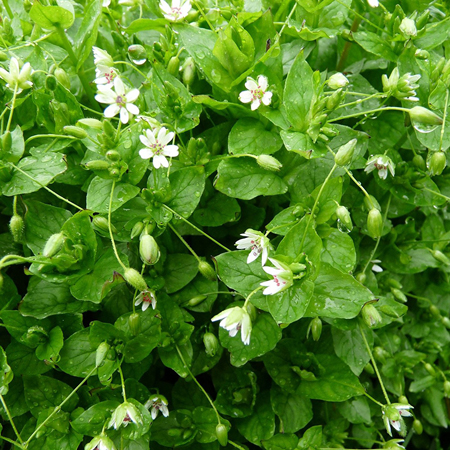
Herb Chickweed In the Kitchen
Chickweed has both vitamin C and A, cancer-fighting agents, and essential fatty acids, niacin, potassium, and rutin that are excellent for your heart, so you can't do much better than to have this wonderful, former weed in your daily diet. The young leaves of Chickweed can be boiled and look and taste much like boiled spinach. Chickweed can also be used fresh in a salad.
It makes a delicious caffeine-free tea. It has a slightly sweet and grassy flavor. Add 1-2 teaspoons to a tea ball or disposable tea bag and cover with hot water. Allow it to steep for five to seven minutes and sweeten with stevia or a little honey.
Growing Tips
When the word “weed” is in the name, you know it’s going to be easy to grow, and Chickweed is. Too easy. It can grow and set seeds in virtually any season, which means containing this herb will be your biggest challenge. It can tolerate cold temperatures down to 7 degrees Fahrenheit or 14 degrees below Celcius. Its only Achilles heel is that it will wilt and die during a drought. But when the rains come, it’s sure to come back. Small wonder, then, that you can find it in all 50 states in the U.S.
The trick with this plant is to keep it from taking over. Keep this herb picked, and make sure it doesn't flower out - unless you want your garden to be overrun with chickweed, that is. ;-) The trick is to harvest the plant before it flowers and then goes to seed.
Chickweed is shade-tolerant and does well in partial shade.
Learn More About Medicinal Herbs
Learn More About Natural Healing
Return from Herb Chickweed to the Home Page
About the Author
My name is Sue Merriam, and I began the journey of self-reliant living more than three decades ago, which enabled me to stay home with my children. Fifteen years ago, I founded Joyful Homesteading to help others save money and face the future without fear. My goal is to give you practical, honest advice so you can save money and experience the joy of simple living. I hope you join me.
Recent Articles


-
Homesteading Legal Restrictions in HOA Communities
Aug 31, 26 05:48 PM
 Homesteading legal restrictions in HOA communities is possible, but check with your HOA and local laws.
 -
Solar Batteries for Emergency Backup During Outages at Home
Aug 19, 26 12:23 PM
 Learn what solar batteries can realistically power in an outage, how long they last, and what works best for you.
 -
Facts About Solar Panels
Aug 15, 26 10:30 PM
 Facts about solar panels are good to know when considering solar power for your off the grid homestead.